
Blog Featured AI in Order-to-Cash: What It Actually Does for Accounts Receivable (and What’s Really Changed)
AI in Order-to-Cash: What It Actually Does for Accounts Receivable (and What’s Really Changed)
Discover what AI in order-to-cash actually does, from prioritising collections and identifying risk to improving payment decisions and cash flow.
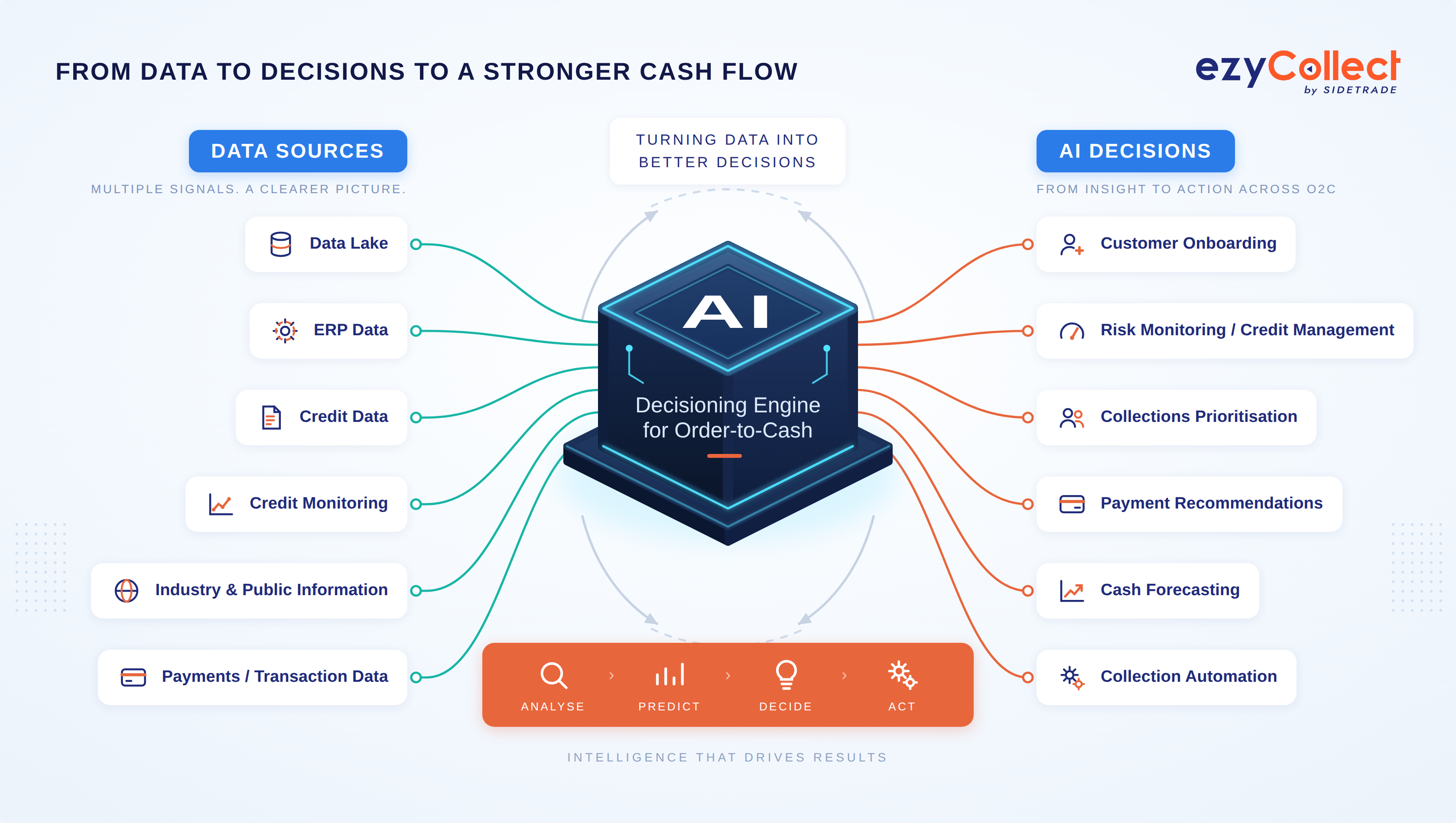
“AI in order-to-cash” (or AI in O2C) is one of those phrases that has quietly shifted meaning. A decade ago, it referred, mostly, to machine learning doing invisible plumbing work such as matching payments to invoices and scoring credit risk. In 2026, it is used to describe something broader: software that reads the entire cash cycle and helps finance teams decide what to do next, enabling better cash flow forecasting and tighter day-to-day cash flow management.
The distinction matters, because “AI-powered” now appears on almost every AR product on the market, and the label covers a wide gap between the tools that genuinely use AI and those that do not. For mid-market finance leaders managing accounts receivable, that difference shows up in faster cash collection, reduced overdue debt, an improved customer experience and the quality of the decisions their teams can make.
What order-to-cash actually is
Order-to-cash is the end-to-end process from taking an order to receiving payment in the bank. It covers credit assessment and onboarding, invoicing, dispute handling, collections, cash application and the reporting that sits across the entire process. It is the cycle that turns an order into a sale, accounts receivable and, ultimately, cash in the bank. For a typical mid-market finance team, it is where a large share of the working week is spent and where better execution can have a direct effect on cash flow.
AI in O2C is an intelligence layer that reads what is happening across these stages and either recommends or performs the next action, account by account and invoice by invoice. It is not a single feature. It is a set of judgements the software can now make using the ledger data you already have.
This article looks at where that intelligence now works in practice across AR: credit assessment, invoicing, collections prioritisation, adaptive chasing strategies, account-level signals and the measurable impact on collection efficiency, bad debt reduction and cash flow forecasting.
A short, honest history

The first genuine machine learning applications in O2C were not customer-facing. Enterprise cash application platforms began using machine learning around 2015 to match incoming payments to open invoices, reaching auto-match rates of 90–95% that no rules engine could match. Credit teams also began using machine learning to weigh live trade data alongside credit bureau scores. Deduction root-cause analysis, dispute classification and payment-date forecasting followed. These were quiet, unglamorous wins that saved thousands of hours each year across large finance functions.
In the mid-market, “AI” often meant something less substantial: rules engines with a smarter marketing story and static workflows that sent reminders on a fixed cadence, dressed up as intelligence.
Two things have changed in the past two years. Real machine learning has become accessible at mid-market pricing, and a new class of AI agents can now take action within the cycle, not simply make recommendations. That combination is why the category feels different in 2026.
Where AI earns its keep in collections today
Five areas, mostly.
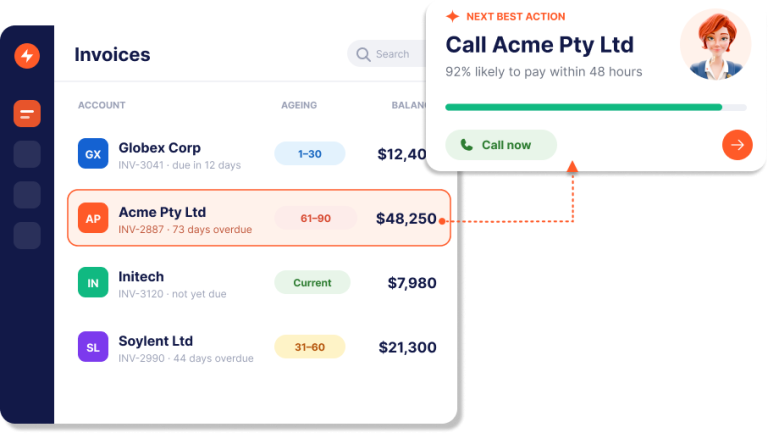
Prioritisation. A collector’s day used to start with an ageing report and their memory of who pays. Good AI reviews every open account overnight, weighs total exposure, promise history, dispute patterns and risk signals, then gives the team a ranked queue by morning. The loudest account no longer gets the attention. The riskiest does.
Chasing that adapts. Sending reminders has been automated for years. What is new is how each reminder is shaped. The channel, timing, tone and cadence can adapt to how each account has actually paid, rather than following a static rule tree that nobody wants to maintain.
Context you cannot build alone. Your own ledger tells you how a customer pays you. Anonymised payment data from across the wider market shows how that same customer pays other suppliers. That is a signal you cannot generate from within your own four walls. It is also where AI in O2C is starting to widen the gap between platforms with real data behind them and those without.
It does not sleep. AI can continuously analyse risk, 24/7. It can quickly detect when a customer’s risk level is increasing and keep the business informed so it can adjust credit limits or prioritise collection activity. At the same time, it helps maintain clear and consistent communication, both internally and externally.
Payments that get smarter. The collections process does not end when a customer says they will pay. AI can learn how each business pays, which payment methods it prefers and where friction causes delays. It can identify customers who may be suited to direct debit or other automated payment methods, prompt the right migration at the right time and continuously assess the risks surrounding those transactions. The result is not just faster payment, but a collections process that increasingly removes the need to chase in the first place.
The account level, not the invoice level
If you are evaluating AI in this category, one distinction cuts through the noise. Most AR tools still work at the invoice level. Each overdue invoice triggers its own reminder, so a customer with six overdue invoices receives six chasers.
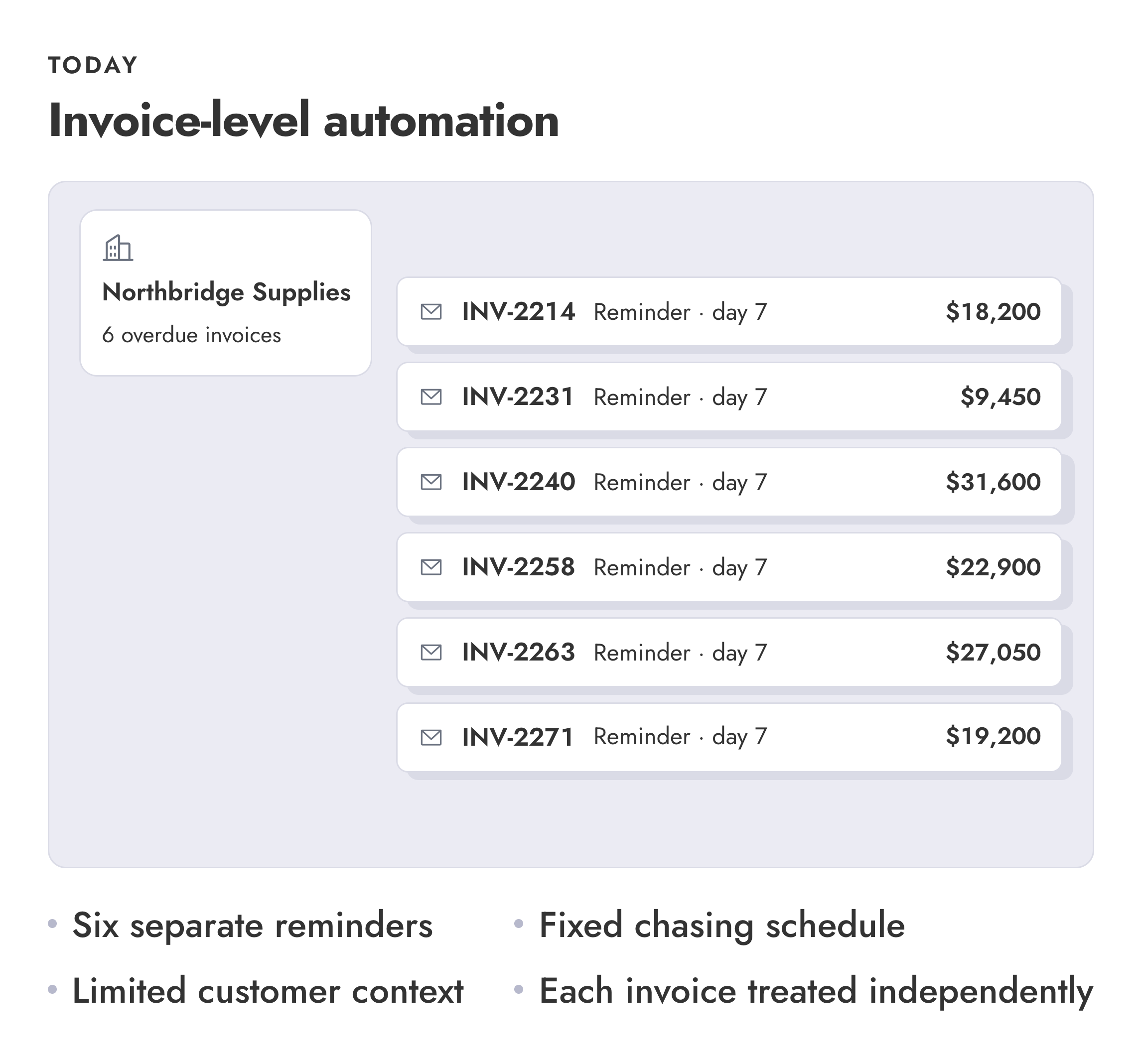

Customers do not behave like a list of invoices. They behave like an account with a story attached: total exposure, past disputes, promises kept or broken and the overall value of the relationship. Tools that read the entire account before deciding what to do perform a genuinely different job from tools that simply send reminders faster. That is where to press when a vendor claims its product is AI-driven.
What the numbers say
At ezyCollect, customers reduce their overdue outstanding balances by an average of 43% within the first twelve months. Across the wider Sidetrade platform, Aimie, our AI for order-to-cash, executed or recommended more than 5.1 million collection actions in 2025 and supported a 49% improvement in cash collection efficiency.

The Sidetrade Data Lake behind it holds US$9.7 trillion in anonymised B2B transactions and is updated with five new payment experiences every second. These are real, audited numbers, not marketing arithmetic.

What AI in O2C is not
It is not a replacement for a collections team, and it should not be sold as one. The best AI in this space removes manual work, not headcount. It can be enabled by segment and used on your terms: automated where you allow it and kept human-led where you do not.
The long tail can be handled by software while your top ten accounts remain fully managed by people. That is a choice, not a compromise, and it is the honest answer for any finance leader who is wary of handing customer relationships to a machine.
One question to take into your next demo
Every AR tool now claims to use AI, so asking, “Does it use AI?” tells you very little.
Ask instead: “What decision does the AI make that someone on my team used to make?”
If the vendor cannot answer that clearly in one sentence, there is a good chance the AI is not really making a decision at all.
Ready to chase smarter? Sign up for early access if you’re already using ezyCollect.
Not an ezyCollect user yet? Talk to our team to learn more.

Related reading
 Chase Smarter. The AI trained on $8.8 trillion in B2B payments, now in your team’s corner.Blog · 12 Jun 2026
 Introducing Early Payment Discounts & Late Payment Penalties: A Smarter Way to Shape Customer Payment BehaviourBlog · 3 Jun 2026
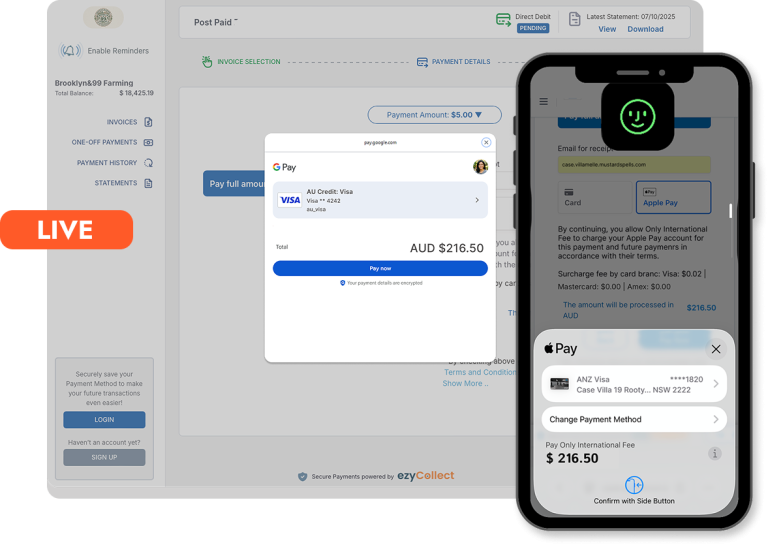 Apple Pay® and Google Pay™ Are Now Live in ezyCollect Payments. Here’s Why Your AR Team Should Care.Blog · 28 Apr 2026