
Blog Payday Super is live. The quarterly float is gone. What CFOs are learning about the new working capital shape.
Payday Super is live. The quarterly float is gone. What CFOs are learning about the new working capital shape.
Payday Super has changed more than the timing of super payments.

The reform is no longer a forecast. It’s a monthly pattern, and the businesses handling it well are the ones that treated it as a working capital event, not a payroll one.
Payday Super came into effect on 1 July 2026, and the quarterly deferral that Australian businesses had quietly built into their working capital assumptions for two decades went with it.
What used to be a quarterly reconciliation problem is now a next-fortnight problem. What used to be a compliance chore is a permanent shift in the shape of cash flow.
For finance leaders, the first cycles under the new rules have made two things clearer than any modelling could. The scale of the working capital pull-forward is real. And the businesses coping best aren’t the ones with the fanciest payroll upgrade. They’re the ones that tightened their cash-flow discipline before the change landed.
The mechanics, plainly
Under the reform, super contributions must be paid at the same time as wages, reaching an employee’s fund within seven business days, rather than 28 days after the quarter closes.
The qualifying earnings base is broader than the previous OTE definition, but in practice, the changes are technical in nature and are not causing many issues for small and medium-sized businesses.
The cost of getting super wrong has increased too. And the ATO no longer needs to wait for an employer to self-assess the problem. Under Payday Super, it can use payroll and super fund data to identify a shortfall, calculate the charge and issue an assessment directly, bringing both the compliance risk and the cash-flow impact much closer to payday.
The ATO is taking a relatively hands-off approach for now, but I expect that to change.
The result is that a super payment that goes late no longer waits three months to become a problem. It can become a Super Guarantee Charge liability within a fortnight and, for directors, a potential personal liability shortly after that, with the ATO having access to the relevant data to automate compliance measures within weeks of the payroll date.The buffer no one wrote down
The buffer no one wrote down
The quarterly deferral was an unwritten working capital line for years.
In my June webinar, Payday Super is coming: what it means for your cash flow, I put an AI-powered estimate on it: around $5 billion in working capital pulled forward across Australian small businesses. For a typical SME, that’s roughly 10% of monthly cash flow, or about a week and a half of runway, permanently removed.
Two factors that amplified the transition
The first is the compound payment.
In July, businesses began paying super with every pay run while many were still settling the final quarterly contribution for the previous June quarter. For a business with a $40,000 monthly super bill, that could mean around $160,000 leaving the bank in a single monthly cycle, roughly four times a normal outlay.
The second is behavioural, and its effects last longer.
Every customer you invoice is dealing with the same tightening of cash flow. Payment delays don’t stay contained to the businesses under the most pressure; they ripple through the supply chain. Average payment times stretch, requests for payment plans increase, and invoices are more likely to be quietly pushed down the priority list.
That is when AR maturity stops being just a collections issue and starts becoming a working capital issue, affecting cash forecasts, payment decisions and how confidently a business can plan for the next month.
In my view, we will see the effects of this in Australia’s September-quarter economic results.
Sector exposure isn’t evenly distributed
Businesses with high wage-to-revenue ratios and thin margins carry the most exposure: construction, hospitality, transport, labour hire and healthcare.
If a business sits in one of these sectors, or sells into them, the second-order effect on receivables can be more meaningful than the first-order effect on payroll.
The Director Penalty Notice backdrop matters here. ATO enforcement was already running at very high levels: in 2024–25, the ATO issued almost 85,000 DPNs covering $5.5 billion in liabilities, against $54.2 billion of total collectable ATO debt.
Payday Super brings that risk closer to the payroll cycle. With super now due within seven business days of payday and the ATO able to assess shortfalls directly, the runway between a missed super payment and potential personal director exposure can compress dramatically, potentially from months to weeks.
For a CFO, that changes more than the compliance calendar. It changes how quickly a super shortfall needs to be identified, escalated and fixed.
It also changes the order of cash-flow priorities and the conversations taking place around the board table. Looking ahead, I expect it to put further pressure on already stretched businesses, potentially contributing to more voluntary administrations and, ultimately, liquidations.
Anecdotally, I’m already hearing of cases where the tighter super payment cycle has become one of the pressures tipping businesses over the edge.
What good practice looks like now
Three questions are worth working through regularly, quarterly at a minimum and monthly for businesses in higher-risk sectors.
Is the cash-flow forecast built to the right cadence?
Payday Super needs to be built directly into the cash-flow forecast. Weekly, and in some businesses daily, forecasting is no longer a nice-to-have.
The number that matters is not the average cash balance across the month, but the lowest point. Knowing your available cash and credit headroom on that day is what separates a manageable position from an exposed one.
Are the AR levers doing enough work?
When cash tightens across the market, control over the timing of receipts becomes more valuable.
Direct debit authorities are one of the strongest controls a business can hold across its customer base. Early-payment incentives, tighter dispute-resolution SLAs and clear escalation triggers all matter more under a compressed cash cycle.
These controls are much easier to build while conditions are stable than to retrofit once customers start slowing payments.
Is there enough liquidity headroom when things do not go to plan?
A cash-flow forecast that works only when every customer pays on time is not much of a forecast.
Finance teams need to understand what happens if collections slip by seven days, a large customer misses a payment, or payroll and super fall in the same week as a major supplier run.
That means knowing the minimum cash buffer required, where additional liquidity can come from, and which payments become critical when cash gets tight.
None of this is particularly sophisticated. It is simply the discipline of treating working capital as something to actively manage, not something you discover at the end of the month.
The change beneath the change
Payday Super was introduced to close the $5.2 billion annual gap in unpaid super. That is the compliance story.
The commercial story is simpler: cash coming in and cash going out are now on a much tighter clock.
A delay in collections is no longer just an AR problem. It can affect business viability, increase directors’ personal exposure and reduce the cash available to keep the lights on, which now includes super paid alongside payroll.
That is the real shift: working capital has become less forgiving.
For finance leaders, disciplined AR management is now, more than ever, a non-negotiable part of cash-flow management.
Want the detail on how the first cycles played out? Watch the on-demand replay of my June webinar, Payday Super is coming: what it means for your cash flow.

Related reading
 AI in Order-to-Cash: What It Actually Does for Accounts Receivable (and What’s Really Changed) Featured · 18 Sep 2026
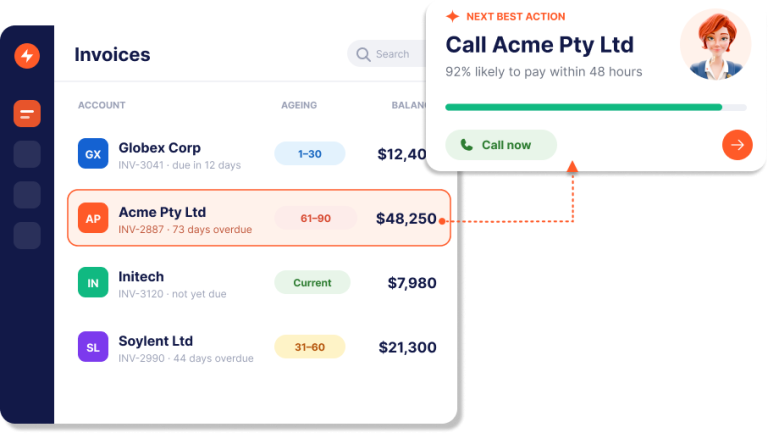 Chase Smarter. The AI trained on $8.8 trillion in B2B payments, now in your team’s corner.Blog · 12 Jun 2026
 Introducing Early Payment Discounts & Late Payment Penalties: A Smarter Way to Shape Customer Payment BehaviourBlog · 3 Jun 2026