
Blog The CFO’s Guide To Accounts Receivables Automation
The CFO’s Guide To Accounts Receivables Automation
In this blog, we'll discuss why AR automation can bring efficiency to your accounts receivables process and improve your...

Accounts receivable automation replaces the manual work of issuing invoices, chasing payment and reconciling receipts. For a CFO the case is a collection-cycle one: PYMNTS research puts firms using manual methods at 25.3 days to follow up on payments, with collection terms 18 per cent longer than businesses that have automated.
Accounts receivables (AR) are a critical component of every business. The AR team is responsible for sending out invoices, billing customers, processing payments, and following up on payments due. Your business’s cash flow and, consequently, productivity and growth hinges on the efficiency of the accounts receivable activities.
Many CFOs strategically deploy AR automation to streamline invoicing, payment processing, acceptance, and collections management. It is imperative for any business that the above activities work in harmony to ensure a healthy cash flow. AR automation is seen as the solution to realise this objective.
In this quick guide, we’ll look at how AR automation can improve different areas in your business by streamlining the efficiency of how you collect payments. We’ll also touch on the problems that often arise from manual accounts receivable processes and why research suggests switching to automation could solve most of these challenges.
The challenges of manual AR processes
Despite the growing demand for AR automation, many businesses still rely on manual AR processes. A 2017 Small Business Trends study showed that about 84% of companies use manual processes such as Excel and spreadsheets. A more recent 2021 report reveals that manual AR processes are still prevalent across industries.
Today’s digital environment calls for fast turnaround times, convenient transactions and customised experiences. Without automation, it can be a challenge to stay on top of your receivables. Here are just a few issues that can affect your AR processes with manual workflows.
1. Inefficient payment acceptance
Manual processes slow down collection processes significantly. Companies across industries experience longer collection cycles when they rely on manual AR processes. The PYMNTS research shows that, on average, firms that use manual methods take 25.3 days to follow up on payments. Firms that have not automated their AR processes have 18 percent longer collection terms than businesses that have adopted AR automation.
2. Poor cash flow
Delayed payments are typically the top cause of poor cash flow for small to midsize businesses. An earlier survey in Australia suggests that 90 percent of small businesses face cash flow issues and go broke due to delayed payments. The 2020 MYOB Business Monitor found that 38 percent of Australian SMEs (small to medium-sized enterprises) feel financially stressed due to late payments, and 42 percent are concerned about cash flow.
3. Higher administrative costs
In addition to poor cash flow, businesses incur increased administrative costs linked to debt collection that involves:
- Collection calls
- Reminder letters
- Receivables emails
- Human resources dedicated to late account collection
4. Impacts productivity
A survey of eleven countries, including the United States, by a consulting firm, Plum, found that manually following up on payments is highly time-consuming. On average, 15 workdays are lost each year in chasing after late payments.
5. Impacts innovation and growth
According to research, 7.5 per cent of invoices are written off ultimately as bad debt. A 3-day delay in invoice due can take away $115,000 from the working capital with a $10 million yearly turnover ($10 million divided by 261 working days). With cash locked up in delayed payments, the potential working capital is frozen – putting financial brakes on innovation investment and scaling up production.
Download the CFO's Guide to AR AutomationPlus, get access to our toolkit of free eBooks, guides, templates and other resources. 
|

|
Improve payment collections with AR Automation
A recent industry survey found that one of the significant barriers to following up on late payments is the lack of dedicated resources. Businesses also report a lack of personnel and staff time as common barriers to payment collection. A significant proportion of companies find it difficult to broach the payment issue with their clients as they fear doing so could harm their future relationships.
With digital processes for invoicing, AR automation effectively handles labour-intensive AR processes such as deductions while accurately capturing and prioritising collections efforts. Integration with an online payment platform also simplifies the process, with a payment write-back that syncs to your ERP while keeping the payment experience simple for your customers.
AR automation brings convenience for both you and your clients, making it an essential tool for a business that is growing.
AR automation by the numbers
According to research, businesses that use AR technologies experience a 23 per cent improvement in payment collections compared to firms that use manual methods.
- 75% of firms reported that AR automation enabled them to offer superior customer experiences.
- 87% of businesses that employed AR automation observed improvements in their overall payment process speed
- 79% of automation adopters agree that it improves team efficiency
- 89% of firms experience faster processes.
The numbers don’t lie. AR automation brings many benefits that impact overall business health – minimising your exposure to risks brought about by manual processes.
Talk to us today to learn more about how AR automation can help your business. Or watch a free demo to see ezyCollect’s AR automation platform in action.

Related reading
 Payday Super is live. The quarterly float is gone. What CFOs are learning about the new working capital shape. Blog · 25 Sep 2026
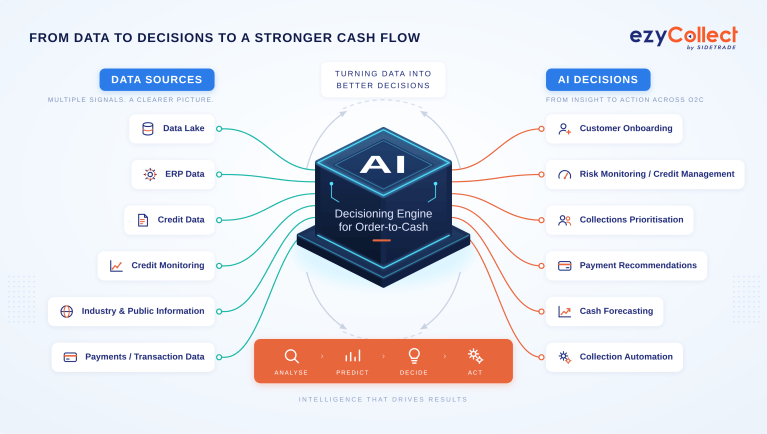 AI in Order-to-Cash: What It Actually Does for Accounts Receivable (and What’s Really Changed) Featured · 18 Sep 2026
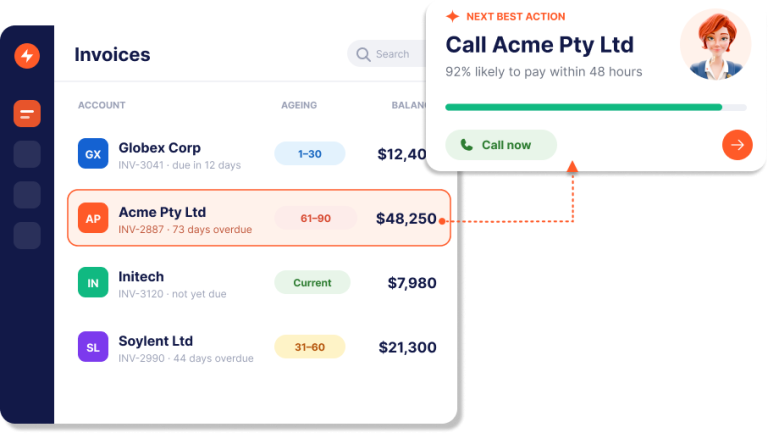 Chase Smarter. The AI trained on $8.8 trillion in B2B payments, now in your team’s corner.Blog · 12 Jun 2026